Beginner's guide

Your money
can work for you.

Investing isn't just for experts. Learn the essentials and start with confidence.

Want more structure? Get the 4-week course — €10.99

Read the investing FAQ →

The magic of compound interest

Move the sliders to see how a regular amount can grow at an average 7% yearly return. Illustration only — returns are never guaranteed.

Estimated value after 20 years

€104,185

You put in

€48,000

Growth from returns

€56,185

There’s more to investing than a projection.

Understand the assumptions behind the numbers, how fees affect results and why losses matter. Explore the four-week course — general education, not investment recommendations.

Preview the course — €10.99

Six steps to get started

01

Emergency fund

Before investing, set aside 3 to 6 months of expenses in an accessible account.

02

Set your goals

Retirement, a home, travel? Your time horizon defines how much risk you can take.

03

Know your profile

Conservative, moderate or aggressive — be honest about how you react to losses.

04

Diversify

Don't put all your eggs in one basket. Index funds (ETFs) are a great start.

05

Invest regularly

Fixed monthly amounts reduce the impact of volatility.

06

Think long term

Time in the market beats trying to time the market.

Want to work through these steps week by week?

The 4-week course turns these six steps into lessons and workbook exercises you complete online. General education, not personal recommendations.

See the course — €10.99

Types of investments

Low risk

Savings & Deposits

Safe, but with modest returns.

Low to medium risk

Bonds

Loans to governments or companies at a fixed rate.

Medium risk

ETFs

Baskets of hundreds of stocks with low fees.

High risk

Stocks

Ownership in companies, with higher potential and volatility.

Digital course

4-Week Investing Course & Workbook

A structured beginner course with lessons, exercises and a practical workbook. Choose your level and the topics you want to study — the course explains concepts in general terms and never tells you what to invest in.

What you receive — €10.99

  • Four weeks of written lessons at your chosen explanation level
  • Practical self-study exercises with explained answers
  • Investment essentials workbook with worked examples and reflection prompts
  • General explanations of the investing topics you choose
  • A saved course to revisit and edit using your verified purchase email

Written lessons and an online workbook — not video lessons or live coaching.

A good fit if…

  • You want the basics explained without jargon.
  • You want to understand ETFs, compounding, costs and risk.
  • You prefer a structured course you can study at your own pace.

Not a fit if…

  • You are looking for stock picks or quick-profit promises.
  • You need advice tailored to your personal finances.
  • You want trading signals or a day-trading course.

Inside the workbook

Less passive reading. More working things out.

Worked examples, comparison prompts and space to reflect — a closer look at the activities that accompany your course.

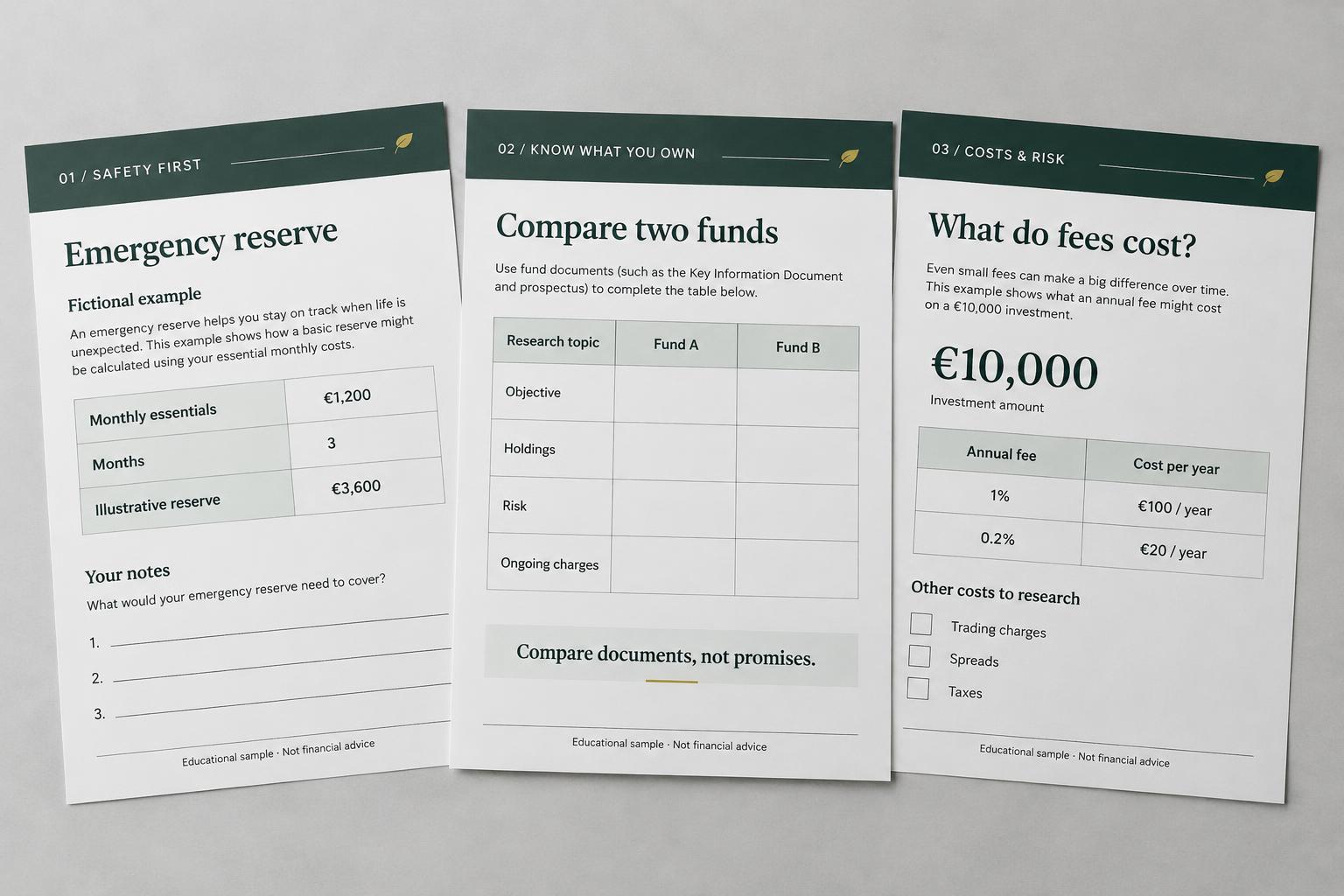
Three illustrative workbook pages: an emergency reserve calculation, a two-fund comparison worksheet and an annual fees checklist.
Illustrative page mockups with fictional examples. The workbook is provided online with your saved course, not as a printed book or downloadable PDF.

01 / SAFETY FIRST

Emergency reserve

Practise with fictional expenses: €1,200 × 3 months = €3,600. An example, not a target for everyone.

02 / KNOW WHAT YOU OWN

Compare two funds

Research objectives, holdings, risk and charges in fund documents. No purchase needed.

03 / COSTS & RISK

What do fees really cost?

Compare annual ongoing charges on a fictional €10,000 balance, then identify other costs to research.

Check the worked answer

€100 versus €20 per year: an €80 difference. Lower fees do not make two products equivalent. Compare their assets, objectives and risks too.

Fee calculations assume a constant balance and exclude trading costs, spreads, taxes and changes in value. Educational samples, not investment recommendations.

Sample lesson · Week 1

Build your safety base before you invest

Level: Complete beginner · Topic: saving vs investing

Lesson

Learn the difference between short-term safety money and long-term money, and why investors usually treat them differently.

Exercise

Hypothetical example: if essential monthly costs were €1,200, a 3-month reserve would be €3,600. Practise the calculation with the worksheet.

Numbers that matter

On €10,000, a 1% yearly fee costs €100; a 0.2% fee costs €20. Over decades, that gap compounds.

Weeks 2–4 cover what you actually own (ETFs, bonds, shares), risk and diversification, and your first investing routine.

Choose what you want to study

Please don't enter personal financial details. The course is educational and doesn't assess your situation.

€10.99 once. No subscription. The free guide stays free.

30-day money-back guarantee

Request a full refund within 30 days. Refund policy

One payment. Saved access.

No subscription. Access after payment confirmation and email verification.

Checkout with Paddle

Payment handled by Paddle, our Merchant of Record. Terms

About this guide

Learn to Invest is created by Rafael Rocha Pardal as an independent, plain-language introduction to investing. It is not affiliated with any bank or broker, earns no commissions from products, and does not recommend specific investments. The goal is simple: help beginners understand the basics well enough to make their own informed decisions.